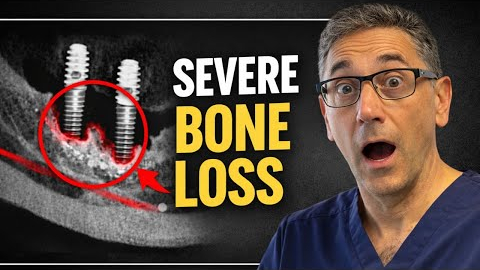
Dental implants typically require strong, healthy bones for long-term success. But what happens when there isn’t enough bone?
For many patients in Poway, CA, severe bone loss has traditionally meant a longer, staged treatment—first rebuilding the bone, then placing implants months later. Today, however, advances in periodontal techniques allow for more flexible options depending on anatomy and overall oral health.
Watch: Learn how severe bone loss can be treated with advanced implant and bone grafting techniques.
Why Severe Bone Loss Often Requires a Two-Stage Approach
In many situations, dental implants cannot be placed immediately when bone loss is severe.
The traditional treatment process includes:
- Rebuilding the bone with bone grafting
- Allowing time for healing and regeneration
- Placing the implant once adequate support is established
This process typically takes several months, but it creates a strong and stable foundation for long-term implant success.
When Implants May Be Placed with Severe Bone Loss
In certain cases, implants and bone grafting can be performed at the same time.
This depends on factors like:
- Available bone height
- Distance from critical structures (such as nerves or sinuses)
- Overall stability at the time of placement
When conditions allow, combining procedures can reduce treatment time while still achieving predictable outcomes.
Understanding the Challenge: Limited Bone Support
Severe bone loss often affects the outer portion of the jaw, leaving a narrow ridge that cannot fully support an implant.
In these situations, part of the implant may extend beyond the existing bone. Without reconstruction, this lack of support can compromise long-term stability.
To address this, the missing bone must be rebuilt around the implant, restoring the natural contour and strength of the jaw.
The Role of Autogenous Bone Grafting
One of the most effective techniques for rebuilding bone is autogenous bone grafting, which uses bone from the patient’s own body.
This approach offers several advantages:
- Strong integration with the existing bone
- Higher regenerative potential
- Improved long-term stability
A small section of bone can be carefully shaped and used to rebuild areas where bone is missing, helping create a solid foundation for implant placement.
You can learn more about this on the bone grafting for dental implants page.
Why Bone Chips Play a Critical Role
While structural grafts help rebuild the shape of the bone, smaller bone particles—often called bone chips—play a key role in regeneration.
These particles:
- Fill gaps between the implant and the surrounding bone
- Support new bone formation
- Provide much of the biological activity needed for healing
When placed and stabilized properly, they significantly improve the success of the grafting process.
Why Implant Positioning Comes First
Successful implant treatment starts with precise placement.
Implants are positioned based on function and long-term restoration goals. Once the ideal position is established, bone grafting is used to build the necessary support around it.
This sequence ensures both stability and proper alignment for long-term success.
To better understand this process, visit the dental implants page.
The Importance of Blood Supply in Healing
Bone healing depends heavily on blood supply.
In some grafting procedures, membranes are used to protect the graft. In others, preserving natural blood flow may be prioritized to support faster and more predictable healing.
The right approach depends on the specific clinical situation and overall treatment goals.
The Most Critical Factor: Soft Tissue Closure
Even with advanced grafting techniques, healing ultimately determines success.
One of the most important factors is tension-free soft tissue closure.
If the gums do not heal properly:
- The graft can become exposed
- Bone regeneration may be compromised
- Additional treatment may be required
Careful surgical technique ensures the area remains protected during healing.
Dental Implants with Severe Bone Loss in Poway, CA
For patients in Poway and nearby areas like Rancho Bernardo, Scripps Ranch, and Escondido, severe bone loss does not automatically rule out dental implants.
At Poway Perio, advanced techniques such as ridge augmentation, bone grafting, and guided implant placement are used to rebuild the foundation needed for long-term success.
Every case is carefully evaluated using advanced imaging and personalized treatment planning to determine the safest and most effective approach. In many cases, patients who were previously told they were not candidates for implants may still have viable options.
If you’re exploring dental implants or have been told you don’t have enough bone, you can schedule a consultation to review your options.
FAQs: Dental Implants and Bone Grafting
Can I get dental implants if I have bone loss?
Yes. Many patients with bone loss can still receive implants with the help of procedures like bone grafting and advanced dental implant treatment.
What is autogenous bone grafting?
It’s a technique that uses your own bone to rebuild areas where bone is missing, improving healing and success rates. This approach is commonly used in advanced surgical periodontal treatments.
Is it better to do bone grafting and implants at the same time?
In some cases, yes. When anatomy allows, combining procedures can reduce treatment time and improve efficiency as part of a comprehensive dental implant procedure.
How long does bone grafting take to heal?
Healing typically takes several months, depending on the severity of bone loss and the procedure performed. Ongoing care like periodontal maintenance helps support proper healing.
Is bone grafting painful?
Most patients report manageable discomfort, especially with modern techniques designed to support healing. You can also review general recovery expectations in healing after gum grafting tips for recovery.
What happens if I don’t have enough bone for an implant?
Bone grafting or alternative treatments may be recommended to create the necessary support. Learn more about your options with bone grafting for dental implants.
How do dentists know if I have enough bone?
Advanced imaging like CT scans is used to evaluate bone structure and plan treatment safely as part of your dental implant consultation.
Are dental implants safe near nerves?
Yes, when properly planned. Imaging and guided techniques used in dental implant procedures help ensure implants are placed at a safe distance from nerves.
What is the success rate of implants with bone grafting?
Success rates are high when procedures are properly planned and performed, especially when supported by ongoing periodontal maintenance care.
Where can I get dental implant treatment in Poway?
You can contact Poway Perio or schedule a consultation to have your case evaluated and explore your options.